IMPACT4IMMERSIVE IDE
Development environment for immersive art installations
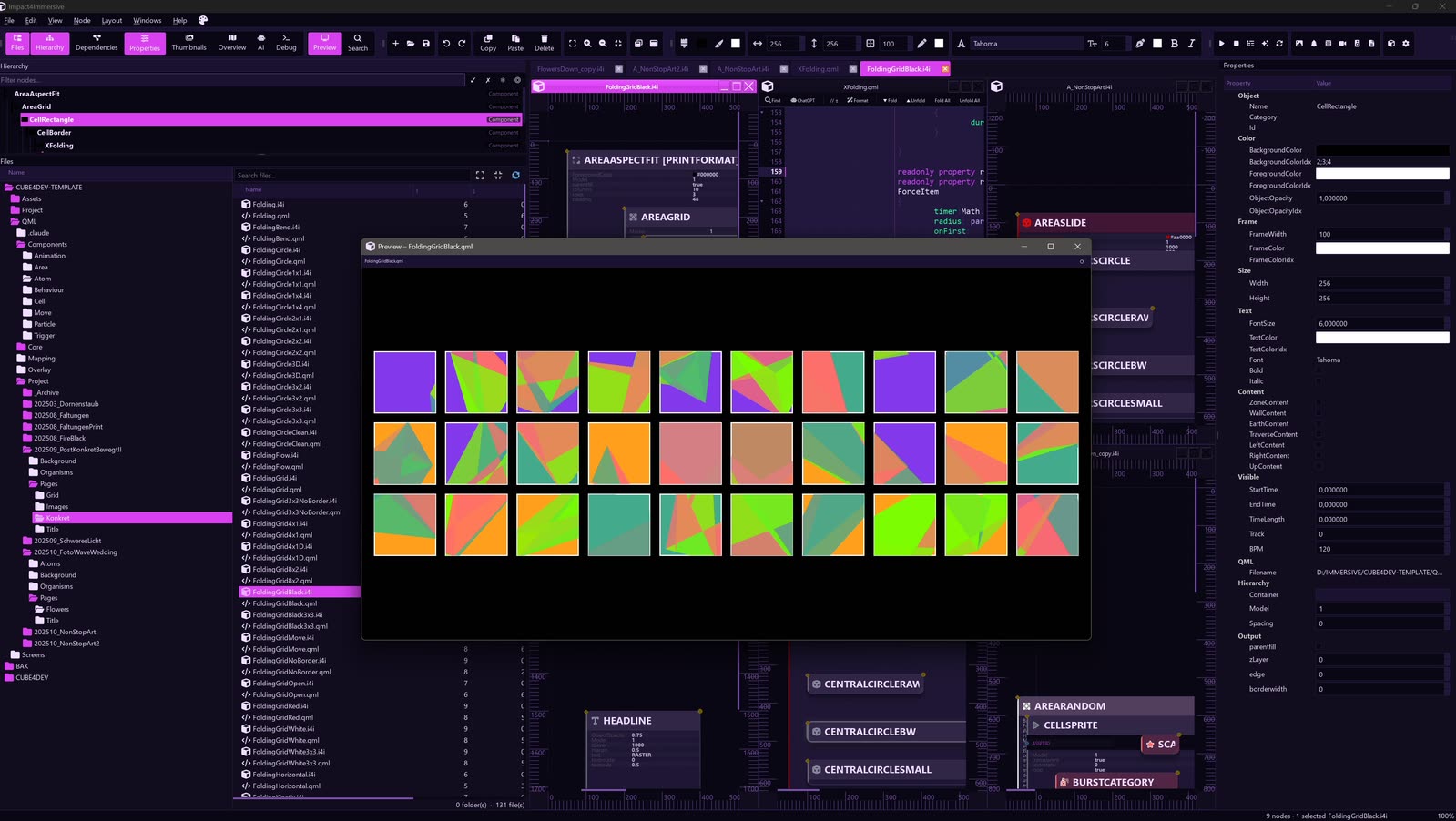
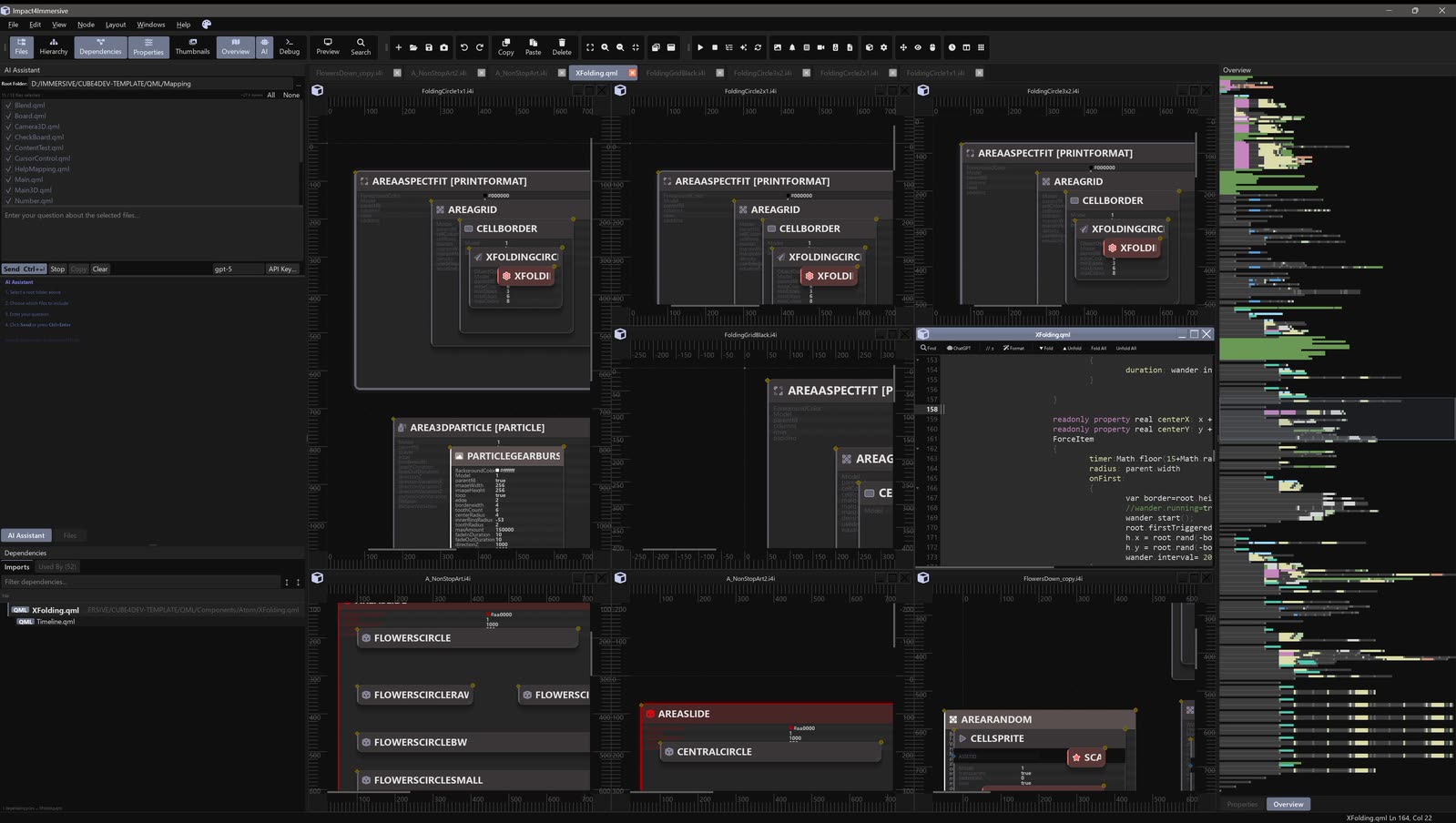
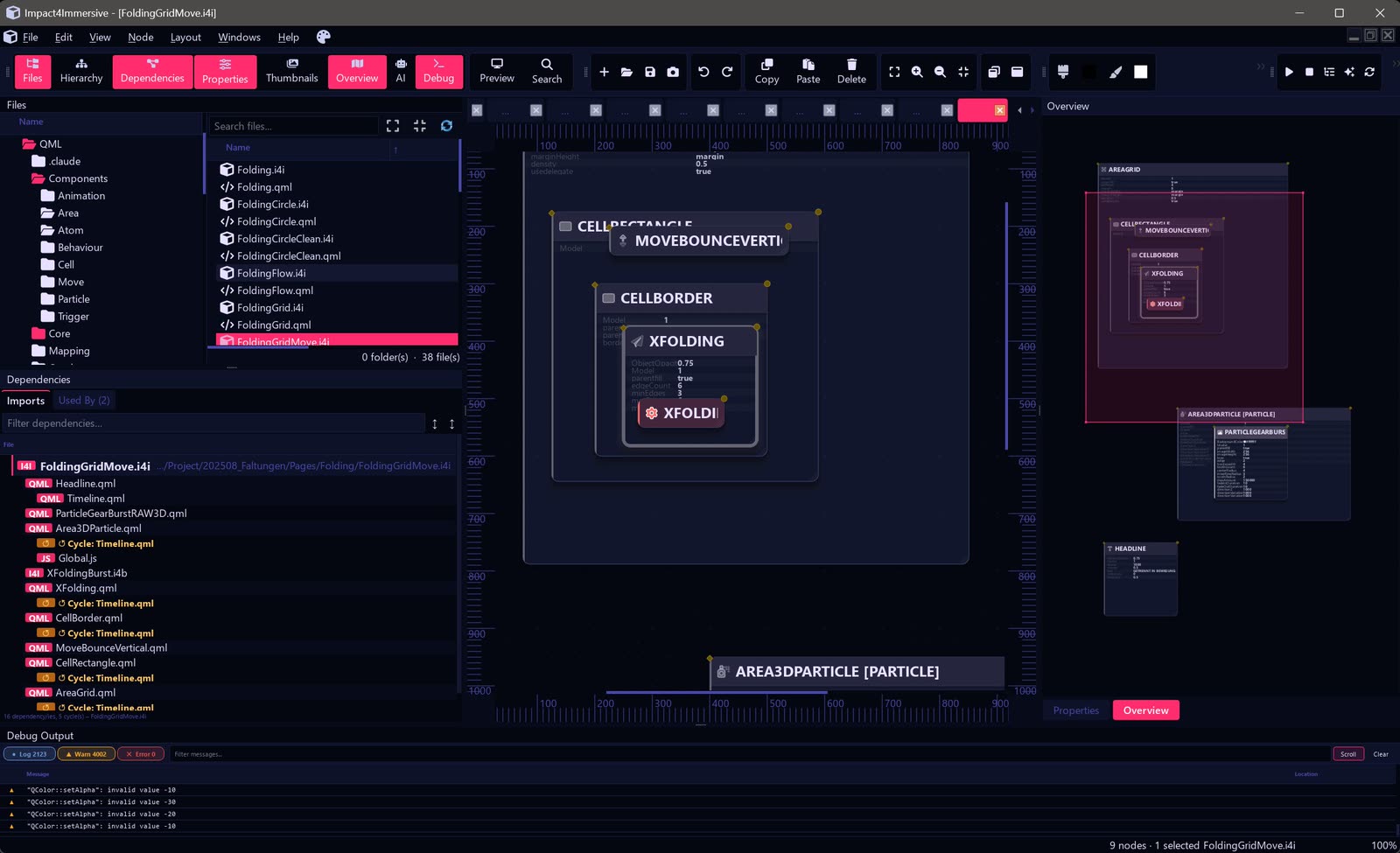
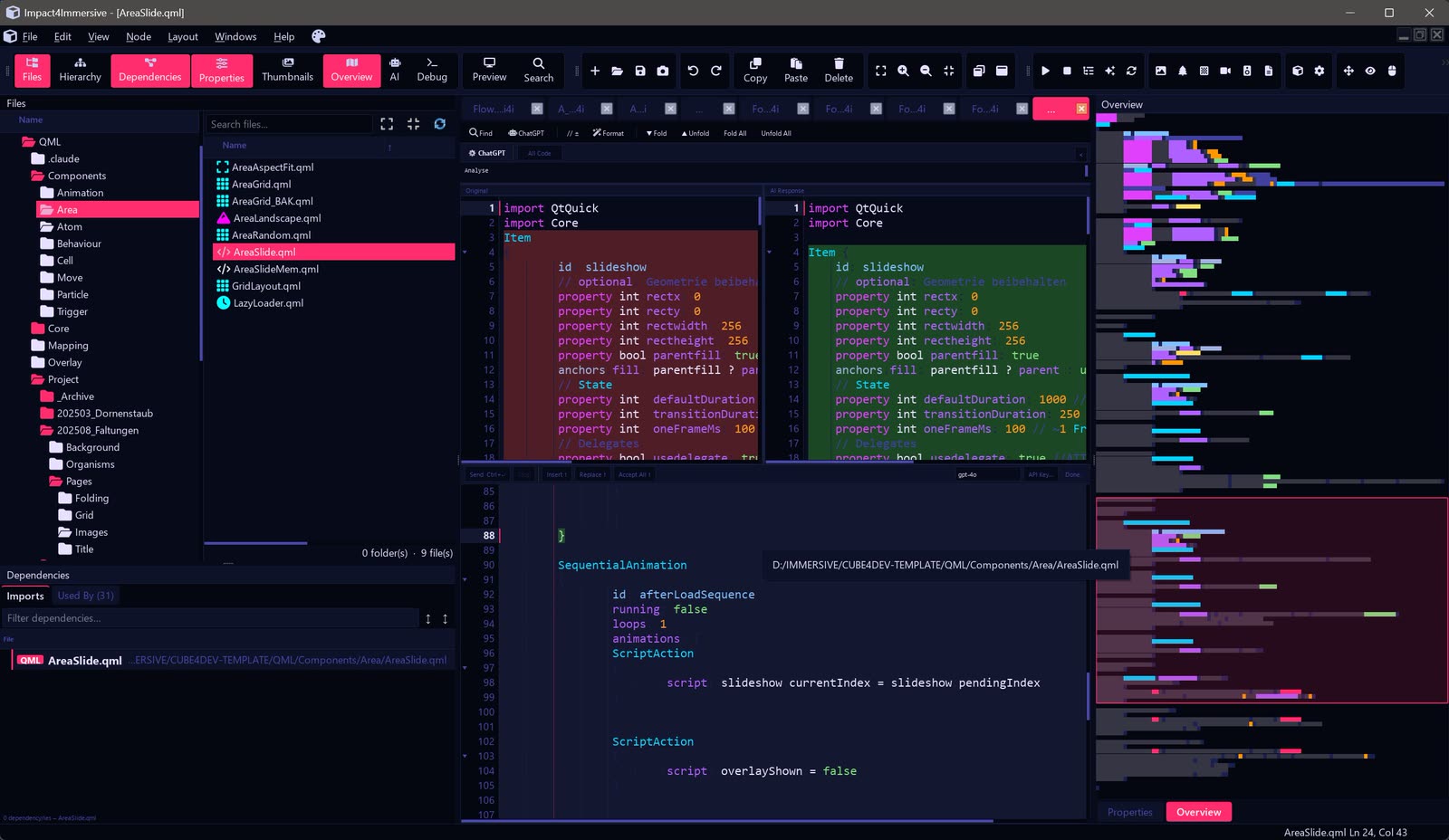
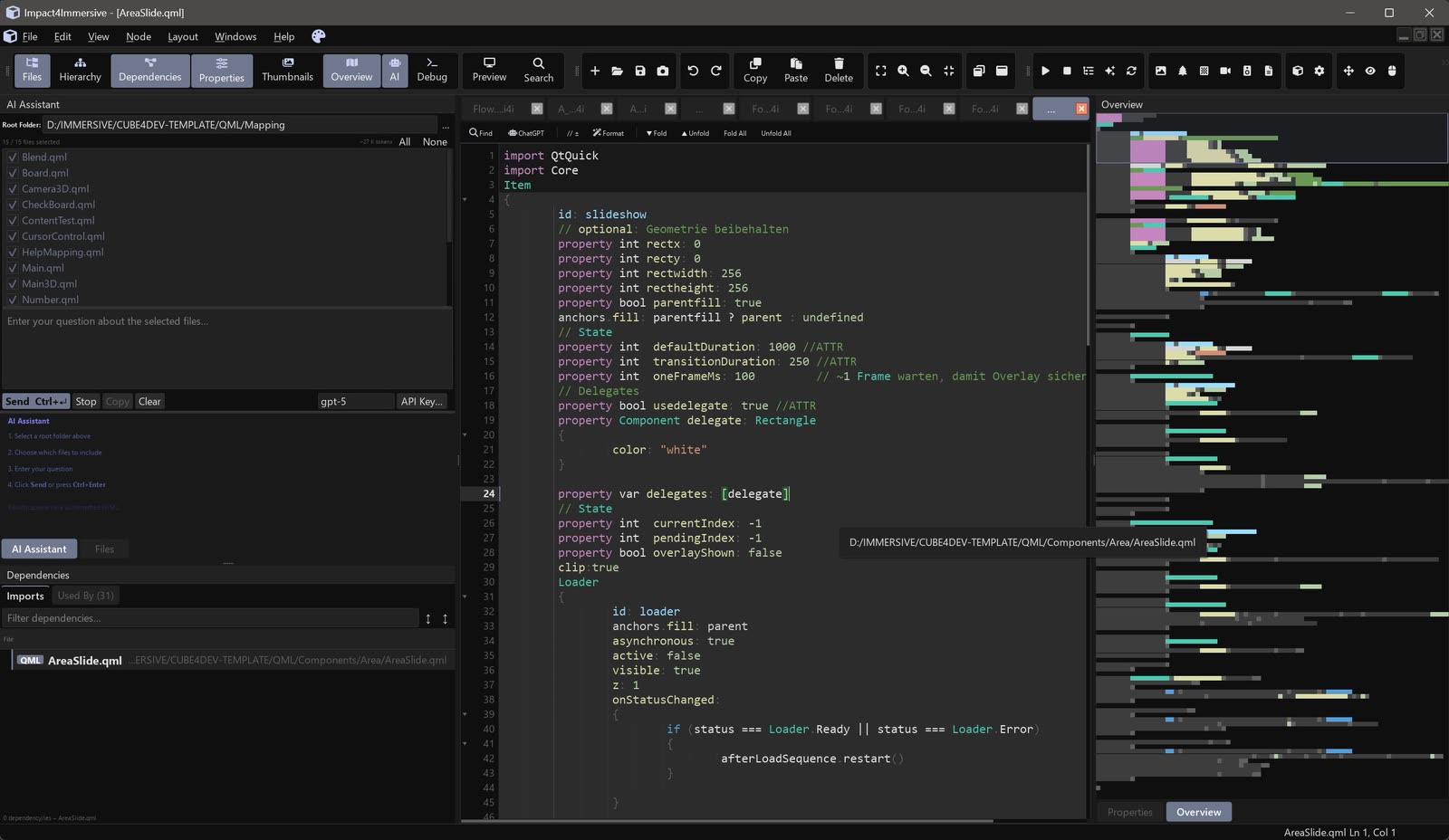
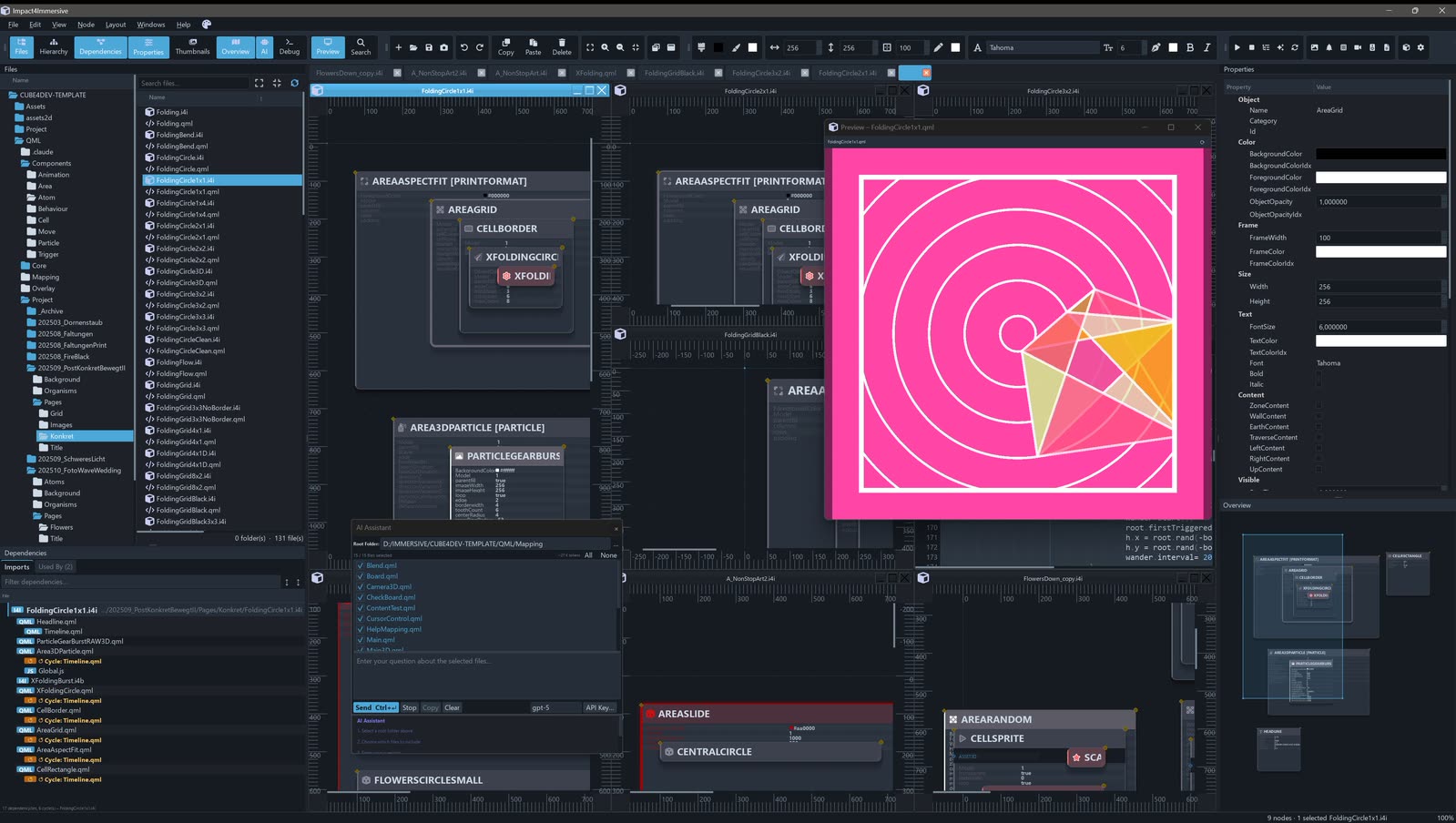
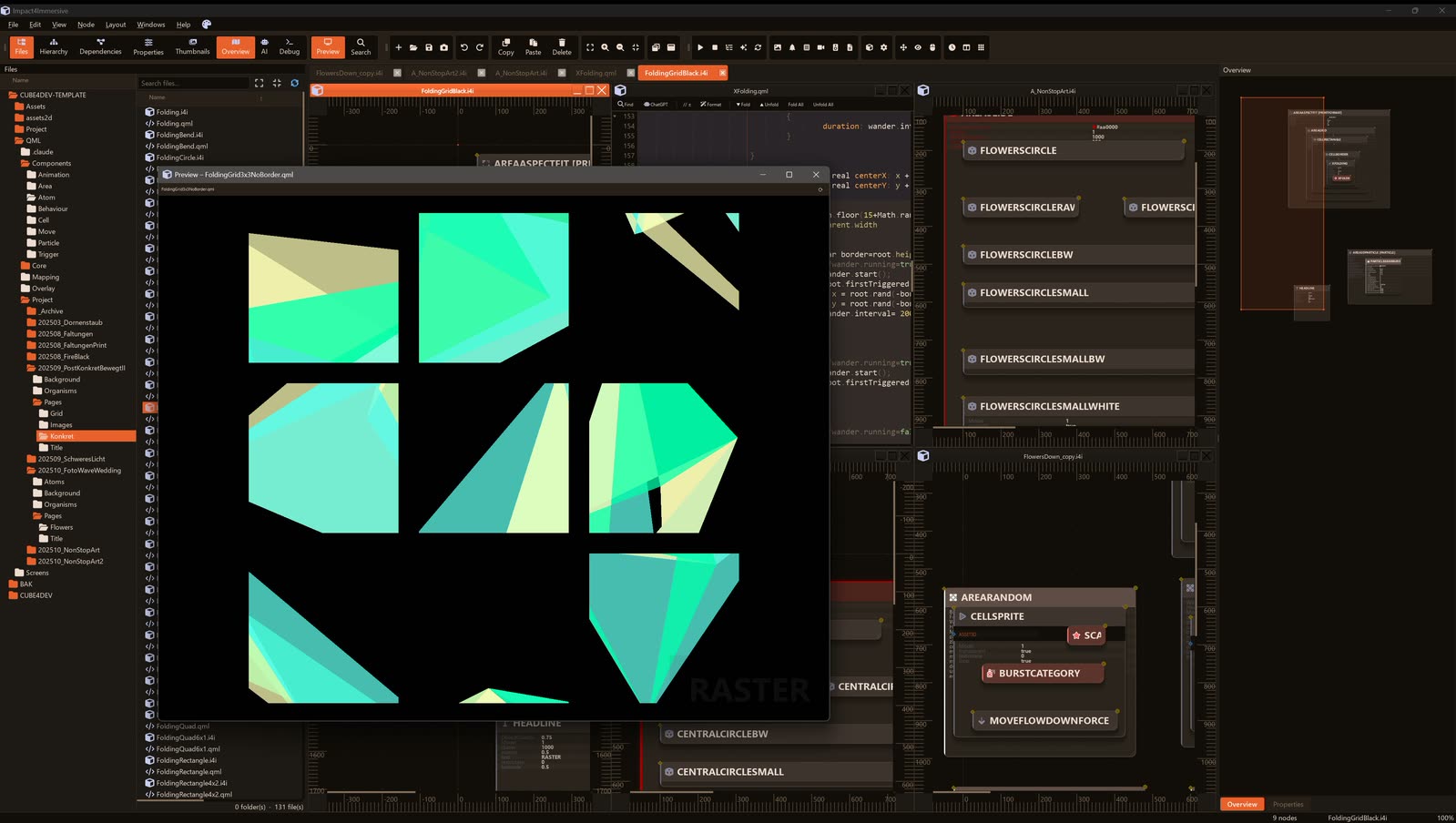
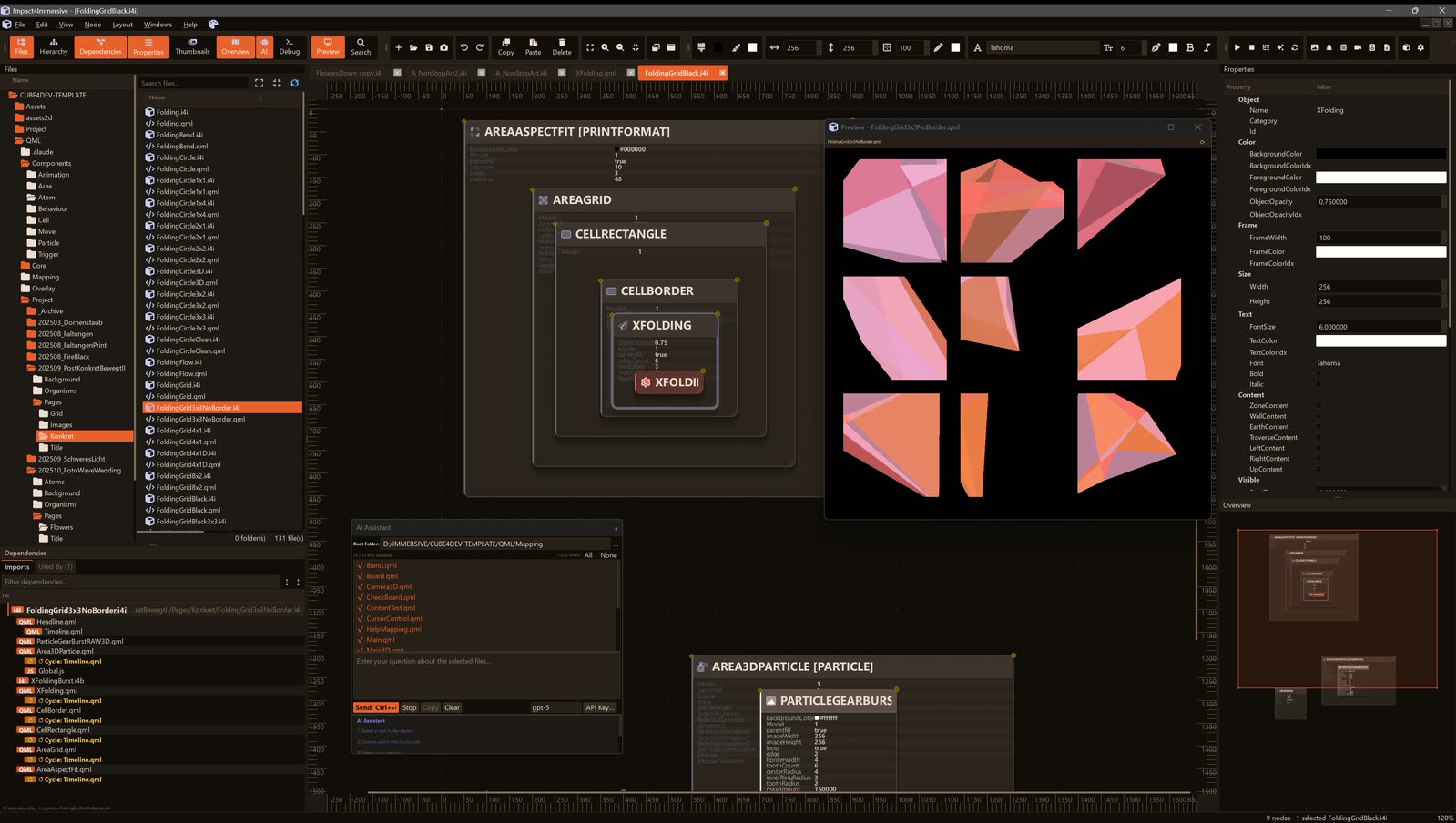
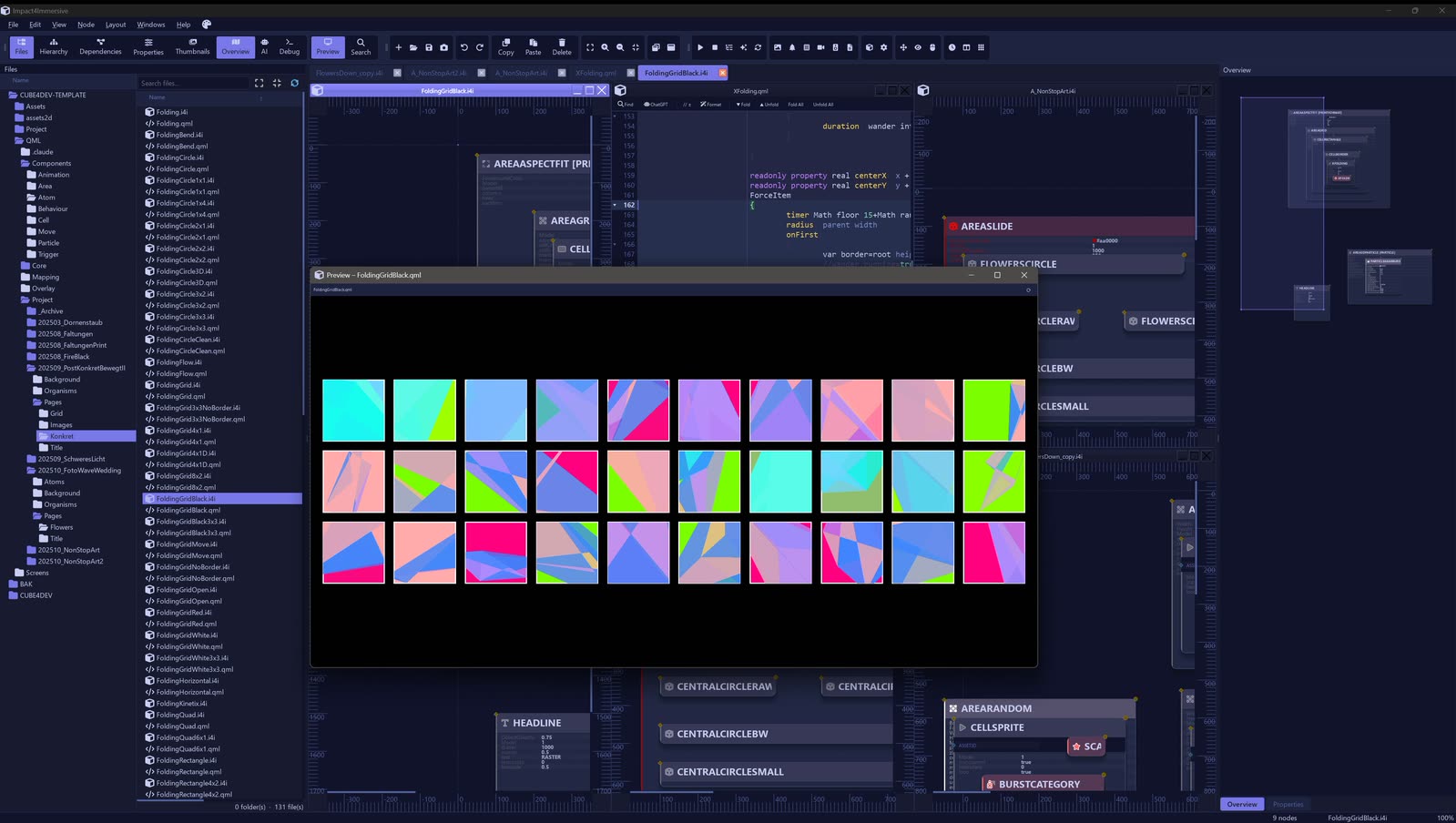
This development environment is designed for the development and production of immersive art installations. Its basis is C++, Qt and QML. The system unites text-based programming with visual scene and behaviour composition, and is aimed at artistic software projects in which image, space, light, movement and interaction arise as one connected structure. The environment is in use in various museum and installation contexts and is used for projects that have to remain reliable both in operation and in further development: in changing spaces, with varying technical conditions, and with requirements for rebuilding, maintenance and extension. Editor, debugging and project structure An extensive code editor supports larger code bases with the usual developer functions such as navigation, cross-references, refactoring and search and replace across projects. An integrated debugger serves the analysis of runtime behaviour and error patterns. A project manager organises source code, modules, media and scenes within a project. Tools for duplicate detection and replacement support the maintenance of recurring content and variants. A property window provides parameters and properties of project-related elements. Node editor for scenes and behaviour A graphical node editor makes it possible to build scenes and behaviour as linked structures. Hierarchies and connections between parameters are shown as a graph and can be used within the project logic - alongside the C++/QML programming.
High integration of 2D and 3D The environment supports 2D and 3D visualisation within one shared project. Image-based surfaces, planar compositions and spatial structures can be combined in a single system. The environment is therefore suited to work that starts from painterly, graphic or light-based placements and at the same time incorporates spatial perspectives, depth or object logics.
AI integration for work on code One focus is an extensive AI integration for work on the code. This includes functions to analyse code (structure, dependencies, faults, consistency), to generate it (functions, modules, prototypes), to extend it (additions to existing systems), and to rebuild it (refactoring, restructuring, migration of parts of a project). The AI is used as a component of the development environment, not as an external aid.
Developed in house for tailored installation projects The system is entirely an in-house development. It is used to realise projects more robustly and more precisely than would be possible with classic, mainstream-oriented game development environments - particularly where installations call for specific combinations of media, control logic, spatial reference, runtime stability and long-term project maintenance.
FREE ARTISTIC ENVIRONMENT A development environment for visually oriented practice and independent artistic project logics.
ART AND EXHIBITION CONTEXTS Installations, painting and digital light works in a curated setting.
INSTITUTIONAL FRAMEWORKS Projects with a long-term structural or documentary dimension.
TEACHING Formats in which complex relationships become comprehensible.
TECHNICALLY DRIVEN SYSTEMS Visual and functional architectures in professional environments.
IMMERSIVE SPACES Fields of information and learning.
TWO- AND THREE-DIMENSIONAL VISUALISATION Presentation of technical content and spatial structures.